

023 — The Eight Precepts of the Fist: A Commentary
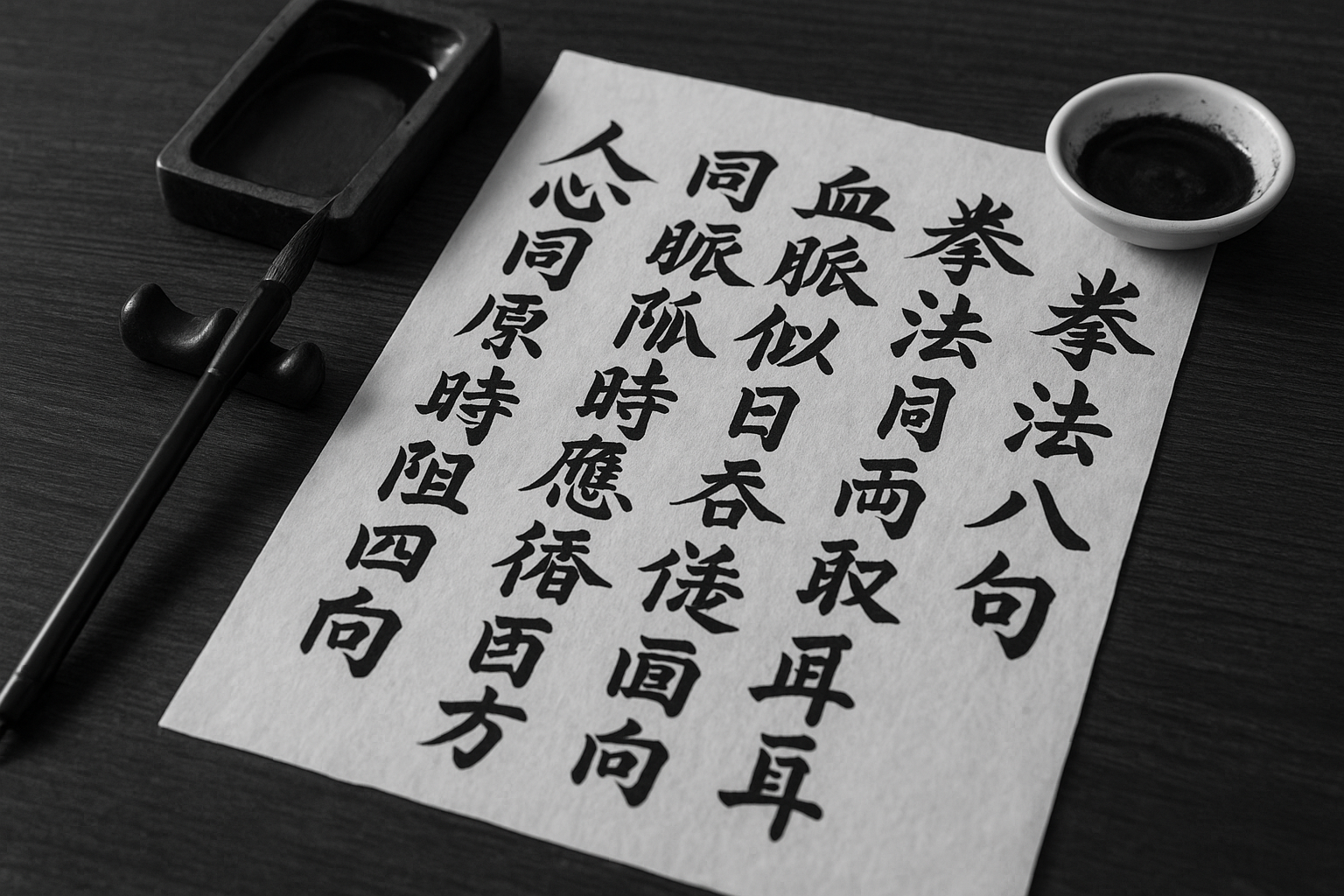
The Way of Karate is not found in strength alone, but in harmony.
Among the relics of early Karate, the Bubishi (武備志) stands as both the most revered and enigmatic. Transmitted from southern China to Okinawa in the nineteenth century, it served not only as a martial manual but also as a comprehensive guide to life. The text comprises lessons on combat, medicine, and ethical conduct, all articulated in the concise style of classical Chinese.
The Bubishi was not a public document. It was hand-copied and privately circulated among teachers and students, regarded as a valuable resource for both physical skill and personal development. Okinawan masters found within its pages technical instruction as well as philosophical insight, linking breath with intent, technique with ethics, and discipline with understanding.
Within its diagrams and treatises is a concise eight-line poem: the Kenpō Hakkō (拳法八句), or The Eight Precepts of the Fist. These verses encapsulate a martial philosophy that frames practice as a means to achieve harmony. Each precept addresses a distinct aspect of training—body, mind, timing, and awareness—yet collectively they present a unified teaching on living in accordance with nature.
In this article, I present a contemporary interpretation of these precepts, approaching them not as mystical aphorisms but as practical guidance for living in harmony with nature, as they may have been understood by Okinawan practitioners.
拳法八句
けんぽお はっこお
Kenpō Hakkō
The Eight Precepts of the Fist
人心同天地
じんしん は てんち に おなじ
Jinshin wa tenchi ni onaji
The human heart–mind is one with Heaven and Earth
Cultivate alignment between spirit and nature
In early East Asian philosophy, the heart–mind (心) was regarded as the seat of both thought and feeling, serving as the center of awareness and moral sense. The term “Heaven and Earth” (天地) denoted the natural order and the vast rhythm of creation. This verse suggests that the human spirit ought to move in harmony with this rhythm, maintaining calmness, balance, and awareness.
In moments of conflict, panic can narrow perception and the ego may distort one’s sense of timing. A spirit that is unified with nature remains composed, with steady breath, relaxed gaze, and broad awareness. From this steadiness, technique emerges without effort: structure remains firm yet flexible, and intent is clear without being forced. This state is known as heijōshin, the ordinary and stable mind that perceives reality accurately and acts at the appropriate moment.
In daily life, this verse serves as a guide to maintaining steadiness. When external factors such as praise or criticism disrupt equilibrium, it is advisable to return to the natural rhythm by focusing on breathing, observation, and measured response. Values should align with reality as it exists, rather than as it is desired. Living as a “spirit aligned with nature” entails meeting change without unnecessary emotional reaction and approaching others with compassion, embodying both stability and kindness.
血脈似日月
けつみゃく は にちげつ に にたり
Ketsumyaku wa nichigetsu ni nitari
The circulation of the blood is like the sun and the moon
Allow effort to follow the rhythm of nature
This verse compares the body’s circulation to the cosmic motion of the sun and moon, reflecting the pulse of day and night, exertion and rest. It suggests that vitality depends on rhythm: the rise and fall, gathering and releasing that sustain both body and spirit. Life progresses in cycles; harmony is achieved by moving with these cycles rather than resisting them.
In Karate, this concept directly informs breath, timing, and energy flow. Power should pulse, expanding and contracting in continual renewal. The Bubishi relates this to “swallowing and spitting” (吞吐), describing the absorption and release of energy in seamless alternation. When breath, structure, and intent align, strength emerges naturally. Each exchange reflects the alternating balance of the cosmos, including assertion and yielding, compression and release.
Beyond the dōjō, life also follows its own tides, such as effort and rest, gain and loss, noise and stillness. Although modern life demands constant motion, the body and mind adhere to more ancient principles. Following nature’s rhythm enables diligent work without burnout, rest without guilt, and trust in renewal. When effort aligns with nature’s rhythm, steadiness replaces strain, allowing both life and training to progress smoothly.
法剛柔吞吐
ほう は ごうじゅう を とんど す
Hō wa gōjū o tondo su
The method of hardness and softness follows swallowing and spitting
Integrate hardness and softness in practice
This verse illustrates that strength and softness function not as opposites but as complementary forces. “Swallowing and spitting” refers to the natural rhythm of breathing, encompassing both absorption and release, reception and expression. The appropriate approach involves integrating firmness with flexibility and decisiveness with sensitivity. Harmony, in this context, is not mere compromise but a dynamic equilibrium that fosters resilience.
Within Gōjū-ryū, this principle constitutes the core of the art. The hard aspect conveys structure, rootedness, and power, while the soft aspect represents adaptability and flow. Synchronization of breath and body enables movement that is both natural and unforced. The practitioner emulates the tide, gathering energy on the inhale and releasing it on the exhale. Thus, technique is transformed from a contest of strength into a demonstration of balance in motion.
In broader life contexts, relying solely on hardness results in conflict, while exclusive softness leads to collapse. Wisdom is demonstrated by discerning when to yield and when to remain steadfast, when to speak and when to remain silent. This principle informs relationships, leadership, and self-discipline. Harmonizing hard and soft enables actions characterized by strength informed by empathy and resolve moderated by grace.
身隨時應變
み は とき に したがって へん に おうず
Mi wa toki ni shitagatte hen ni ōzu
The body follows the time and responds to change
Respond appropriately to prevailing circumstances
This precept emphasizes that right action is contingent upon appropriate timing. The character 時 signifies “the proper moment,” while 應變 denotes “to respond to change.” Collectively, these concepts convey that wisdom consists in acting when conditions are optimal, not by forcing or resisting, but by adapting.
In application, this principle becomes the art of timing and proportion. After internalizing rhythm and balance, one’s actions must correspond to the present moment. By assessing rhythm, distance, and intent, the practitioner allows circumstances to determine the appropriate response. Form serves as a guide rather than a constraint; responses should remain fluid rather than rigid. The skilled practitioner acts neither prematurely nor belatedly, but in precise accordance with the situation.
Outside the dōjō, this principle becomes discernment in action. One must consider what the present moment demands: whether to speak or listen, to advance or pause, to act or wait. Right action is not static; it is relational. By aligning with actual circumstances rather than personal preferences, individuals act effectively and without excess. This constitutes practical wisdom, where clarity is integrated with proportion.
手逢空則入
て は くう に あいて すなわち はいる
Te wa kū ni aite sunawachi hairu
When the hand meets emptiness, then enter
Act with decisiveness at the appropriate moment
In this context, “emptiness” (空) refers to openness, defined as the absence of resistance. The verse emphasizes the importance of decisive timing: when the path is unobstructed, one should act. Hesitation eliminates opportunity, whereas appropriate action emerges from a state of readiness and heightened awareness.
During combat, when an opponent’s guard or intent diminishes, it is essential to advance. Waiting for absolute certainty results in missed opportunities. Such initiative arises from composed perception. In kakie, practitioners cultivate sensitivity to this “emptiness” through tactile feedback and precise timing. A body that integrates both firmness and flexibility, and adapts to changing circumstances, responds instinctively when an opening presents itself.
In broader life contexts, “acting decisively when the time is right” entails recognizing and seizing emerging opportunities. When a path becomes clear, a conflict diminishes, or a chance arises, many individuals hesitate, whereas those with wisdom take action. This approach reflects not recklessness, but rather the union of courage and discernment. A prepared individual acts without compulsion, trusting that the appropriate moment becomes evident to those who remain attentive.
碼進退離逢
しんたい は しんたい りほう す
Shintai wa shin-tai ri-hō su
The stance advances and retreats, separates and meets
Maintain equilibrium between engagement and withdrawal
This verse articulates balance in motion, emphasizing the rhythm of advancing and retreating. Stability is defined not as stillness, but as poise maintained amid continual change. True balance involves moving in harmony with cycles of engagement and release, discerning appropriate moments to enter or to yield.
Within Karate, this principle manifests as the rhythm of distance and timing. Advancing without awareness results in recklessness, while retreating without intention leads to disadvantage. When engagement and withdrawal are integrated, movement becomes deliberate and effective. The body remains centered, avoiding rigidity and dispersion. In kata, forward and backward steps correspond to inhalation and exhalation, each sustaining the other.
Outside the dōjō, this principle extends to the broader rhythm of life. Certain situations require engagement, such as action, speech, or leadership, while others necessitate withdrawal, including listening, reflection, or creating space. Continuous engagement without rest leads to exhaustion, whereas withdrawal lacking courage results in isolation. Genuine steadiness is demonstrated by the capacity to alternate between these states with conscious awareness.
目要視四向
め は しほ を みる を よす
Me wa shiho o miru o yosu
The eyes must observe in all directions
Perceive each situation with clarity
The eyes symbolize discernment, representing the capacity to perceive truth without distortion. To “observe in all directions” signifies comprehensive perception, encompassing both proximity and distance, detail and pattern, as well as immediate moments and their consequences. Clarity arises not from intellectual manipulation but from a tranquil mind that enables phenomena to present themselves authentically.
Within martial practice, this precept cultivates awareness grounded in composure. To “see every situation clearly” involves perceiving more than mere movement; it requires sensing rhythm, distance, and intent simultaneously. When the eyes remain relaxed and the mind calm, attention broadens. Such clarity prevents fixation and enables intuitive timing.
Outside the dōjō, clear perception entails understanding without bias, recognizing both events and their underlying causes. This ability allows one to discern the essence of a situation without influence from emotion or ego. Clarity reveals proportion, distinguishing what is significant from what is not. Through clear perception, actions are guided by calm insight rather than impulsive reaction.
耳能聽八方
みみ は よく はっぽう を きく
Mimi wa yoku happō o kiku
The ears must listen in all directions
Engage in attentive and comprehensive listening
The ears symbolize openness and empathy, representing awareness achieved through attentive silence. To “listen in all directions” encompasses more than auditory perception; it involves sensing tone, silence, and meaning, as well as the world’s subtler rhythms.
Within martial practice, listening signifies heightened sensitivity. The advanced practitioner perceives through all senses, including touch and intuition. In kakie, one learns to detect tension, rhythm, and intent before they become apparent. Authentic listening necessitates inner silence: when the mind is calm, perception expands; when it is restless, awareness diminishes.
In life, to “listen deeply to all things” is to foster connection with others, nature, and oneself. While many individuals hear only to respond, few listen with the intent to understand. Deep listening constitutes empathy in practice and awareness free from judgment. As individuals cultivate both external and internal listening, actions become more grounded, relationships strengthen, and harmony is restored.
The Kenpō Hakkō commences with unity, signifying the alignment of the human spirit with nature, and culminates in awareness: eyes that perceive clearly and ears that listen deeply. When perception and listening are fully realized, harmony is achieved. The Eight Precepts thus return to their core principles: awareness, balance, and alignment with the fundamental rhythm of life.
This progression from harmony to perception, and subsequently returning to harmony, illustrates a complete cycle of practice and realization as described in the poem.
The message is both straightforward and demanding. Strength and softness, action and stillness, engagement and withdrawal are not opposites but rather complementary rhythms within the same dynamic current. Proficiency in Karate reflects proficiency in life, characterized by timing, proportion, and awareness. As perception and listening deepen, the spirit more naturally returns to harmony with the world.
For the martial artist, this represents the highest purpose of training. The Kenpō Hakkō serves not as a code for combat, but as a guide for balanced living, fostering sensitivity, restraint, courage, and compassion. Its wisdom extends beyond self-defense to encompass self-mastery.
When perception is clear and listening is profound, harmony is restored. The cycle concludes where it began, in unity with Heaven and Earth. Through dedicated practice, awareness returns to stillness, and stillness becomes the Way.