

024 — From Ti to Trophies: What Happened to Real Karate?
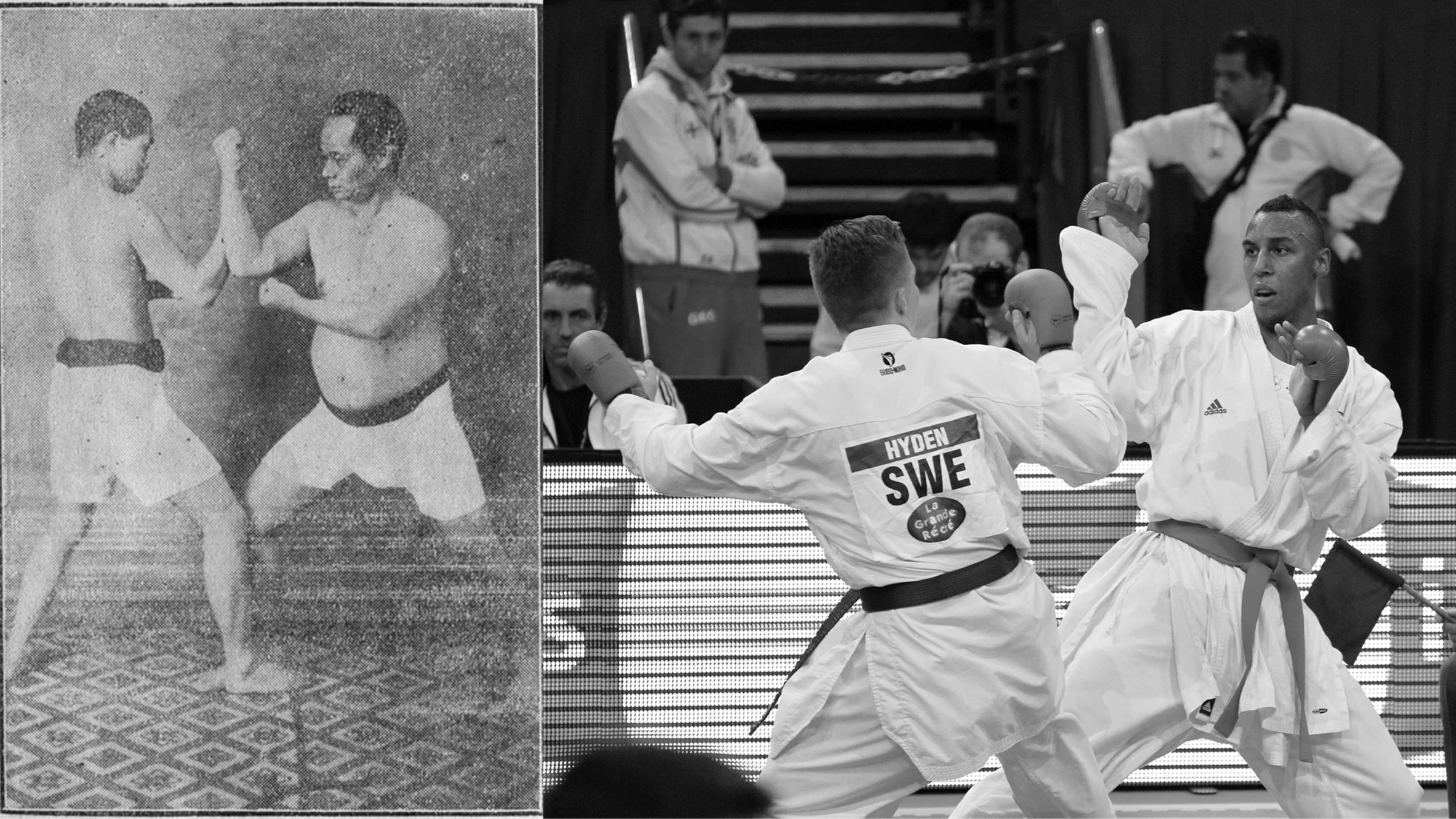
Karate as it was practiced—and as it is often performed today.
Close-range training develops timing, sensitivity, and control beyond what is visible, while modern competition prioritizes distance, scoring, and visual clarity over continuous engagement.
Left image: Public domain (Wikimedia Commons).
Right image: Claus Michelfelder, via Wikimedia Commons, CC BY-SA 3.0 (modified).
In dōjō around the world today, Karate is practiced by students of all ages — from toddlers in oversized keikogi to middle-aged professionals seeking fitness and focus. Many schools promote themselves as family-friendly and accessible to everyone, offering the same class structures and curricula regardless of practitioners’ ages. At first glance, this seems like a positive evolution — a democratization of the martial arts.
But beneath the surface lies a critical problem: Much of the Karate taught today, to both children and adults, has been fundamentally altered to suit a demographic it was never intended for.
The truth is both unsettling and straightforward: most Karate taught to adults today is essentially children's Karate.
This is not a criticism of training for children, but of applying that same training to adults without progression.
The Commercialization of Karate
This phenomenon did not arise by accident. It was born out of economic necessity. As Karate spread beyond Okinawa and into the global marketplace, it needed to survive, which meant filling dōjō with paying students. Children quickly became the bread and butter of martial arts schools. They were easier to recruit, retain, and manage, thanks to eager parents and flexible after-school schedules. Over time, Karate was reshaped to cater to this new audience. Techniques were simplified, drills sanitized, and sparring reduced to controlled exchanges. A steady stream of colored belts ensured that motivation remained high.
This version of Karate then became the default.
Generations of children grew up in it, and when they became instructors, they passed on what they had learned, believing it to be complete. It was not. And thus began a self-perpetuating cycle of dilution in which the true depth and danger of Karate were quietly erased.
What Karate Once Was
Before there was bread and butter—before tuition and trophies—there was Ti, later known as Toudi, and eventually Karate: a martial practice cultivated within the Ryūkyū Kingdom.
While Karate is often described as a peasant art, much of its early development and preservation occurred within the yukatchu—the educated Okinawan aristocracy responsible for administration and diplomacy. These were men of position and learning, often sent to China for scholarly and diplomatic exchange, who studied martial arts not as recreation, but as a means of self-cultivation and practical application. They had both the means and the context to study, refine, and transmit these methods with intention.
Ti was not a child's pastime. It was a rigorous and potentially dangerous discipline—deliberately kept private and practiced with restraint. It included body conditioning, joint manipulation, close-quarters engagement, and combative strategies unsuitable for young minds and bodies. These methods required maturity—physical, emotional, and psychological.
Why would such material be taught to children? It wouldn’t be. It wasn’t. And it shouldn’t be.
The Rise of "One-Size-Fits-All" Karate
Yet today, in many dōjō, you'll find children and adults practicing side by side, working from the same syllabus, at the same pace, and with the same expectations. It is Karate stripped of its severity — made digestible, commercial, and safe.
Several factors contributed to this shift:
Commercial Incentives: Dōjō standardized curriculum for operational efficiency and financial gain, often prioritizing enrollment over rigor, depth, or authenticity.
Simplification for Mass Appeal: To accommodate a wide age range, curricula are diluted to a mix of basic techniques, kata performance, and point sparring — the "Three K's" as it became known: Kihon, Kata, and Kumite.
Safety Concerns: Realistic, high-level techniques such as joint locks, throws, and powerful strikes are often omitted or heavily modified to ensure safety and reduce liability.
Lack of Specialized Instruction: Instructors raised in these child-friendly programs often lack the experience or resources to provide truly mature, adult-focused training, even if they desire to do so.
The result? Adults receive instruction developed for children. The art stagnates. Its integrity erodes.
The Wake-Up Call
The rise of the UFC and mixed martial arts (MMA) exposed a critical weakness in the way many traditional arts were practiced. In the early days of the UFC, practitioners from a range of disciplines—including Karateka—entered the octagon to test their training under pressure. What followed was a clear and public realization: many traditional martial arts, as commonly taught, did not translate effectively in live, unscripted combat.
Point sparring, compliant drills, and rote kata offered limited preparation for grappling, continuous striking exchanges, and the unpredictability of real resistance. As a result, Karate was widely dismissed as outdated and impractical.
And yet, this conclusion was incomplete.
Lyoto Machida—a lifelong Karateka and son of a respected Okinawan stylist—entered the octagon with a markedly different approach. His training emphasized timing, distancing, evasive movement, and precise, decisive striking rooted in a traditional combative framework. When Machida began defeating high-level opponents, it forced a reconsideration.
He did not introduce something new. He revealed what had been lost.
Machida did not demonstrate a different Karate—he demonstrated a different way of training.
Machida showed that Karate is not ineffective—the way it has been taught to most people is.
Karate did not become ineffective—it became misaligned with its original purpose.
It Went Unheeded
In 2021, Karate made its Olympic debut—an event many believed would validate the art on a global stage. Instead, it revealed a fundamental disconnect between performance criteria and combative reality.
Kata competition emphasized exaggerated expression: heightened tension, dramatic pacing, and stylized movement designed for visual clarity and judging. While technically precise, these performances often prioritized form over function, presentation over application. What was displayed was not necessarily incorrect—but it was incomplete.
This same tension became even more apparent in kumite.
In the men’s final, Saudi Arabian competitor Tareg Hamedi delivered a well-timed mawashi geri, knocking out his opponent. Under a different ruleset, the technique would have been decisive. Instead, he was disqualified for excessive contact, and the match was awarded to his opponent.
The outcome was not controversial because of the rules themselves, but because of what they revealed: a format in which effective technique could result in a penalty rather than success.
Rather than clarifying Karate’s combative value, the Olympic format highlighted its evolution into a rule-bound performance system—one increasingly distant from its original function.
In 2022, Karate was removed from the Olympic program.
This was not simply a programming decision; it reflected a broader uncertainty about what Karate represents: a method of combat, or a system of performance.
Real Karate was never designed for display. And when it is evaluated primarily through that lens, its purpose becomes difficult to recognize.
The Way Forward
Let’s be clear: there is nothing inherently wrong with teaching Karate to children. When done appropriately, it can be one of the most valuable experiences a young person can have—helping them develop discipline, coordination, focus, and confidence.
But it is a mistake to treat that version of training as complete.
Adults require something different. They require an art that reflects their physical reality, their emotional resilience, and their capacity for deeper understanding—one that conditions the body, challenges the mind, and develops practical skill under pressure. This requires not just different techniques, but a different standard of training.
The solution is straightforward in principle, but difficult in execution. Karate must move beyond a generalized model. What is introduced to children should not be mistaken for the full expression of the art, and what is offered to adults must go further—both in depth and in intent.
This requires a shift in how we think about training: not as a uniform curriculum, but as a progression toward maturity.
If you are an instructor, the question is not whether your students are learning; it is what they are being prepared for. Are they developing real capability, or simply progressing through a system designed for retention and accessibility?
The future of Karate depends on a willingness to re-examine its purpose, not only in its techniques but also in its structure, pedagogy, and expectations.
Karate did not lose its power; it lost its context.